
A domestic supplier near Tesla's gigafactory has investors paying attention (From i2i Marketing Group, LLC)
Key Points
- Intel's 430% rally in the last year has given the company new momentum, even as investors may be overlooking its potential in the quantum computing space.
- Support from the CHIPS Act and important deals with Apple and NVIDIA are likely to benefit Intel's classical computing efforts as well as its quantum approach.
- Still, smaller pure-play rivals like Rigetti Computing and D-Wave hold some important advantages.
- Special Report: One trusted friend changed his mind about a 2,000-percent track record (From Porter & Company)
The big players have shown up to the quantum computing race, and the results could be disastrous for smaller names. IBM Corp. (NYSE: IBM) notched two big wins in recent weeks, securing $1 billion in foundry funding from the federal government and leaning into quantum R&D with $10 billion in planned internal investments.
Now, Intel Corp. (NASDAQ: INTC) appears intent on making its presence in the space known as well.
This starts with Intel's remarkable share price comeback: INTC shares are up about 200% year-to-date (YTD) and an incredible 430% over the last 12 months, having catapulted to new all-time highs in the process.
A number of different factors have likely contributed to this mega-rally, including CHIPS Act grants, a foundry deal with Apple Inc. (NASDAQ: AAPL), and a surprise $5-billion equity deal by rival NVIDIA (NASDAQ: NVDA).
But quantum computing may be its most powerful hidden weapon.
A tiny supplier at the center of Elon's AI infrastructure (Ad)
The upcoming SpaceX IPO - reported for June 12 - is valued at $1.75 trillion. But one analyst says fighting over those shares may be the wrong move.
There's a tiny supplier, just 1/60th the size of SpaceX, sitting at the center of what he calls Elon Musk's 'tollbooth' plan for AI infrastructure. Once SpaceX goes public, Wall Street could expose this under-the-radar vendor to a much wider audience.
Watch the urgent presentation to see this hidden stock before the IPO window closes
A Major Manufacturing Advantage
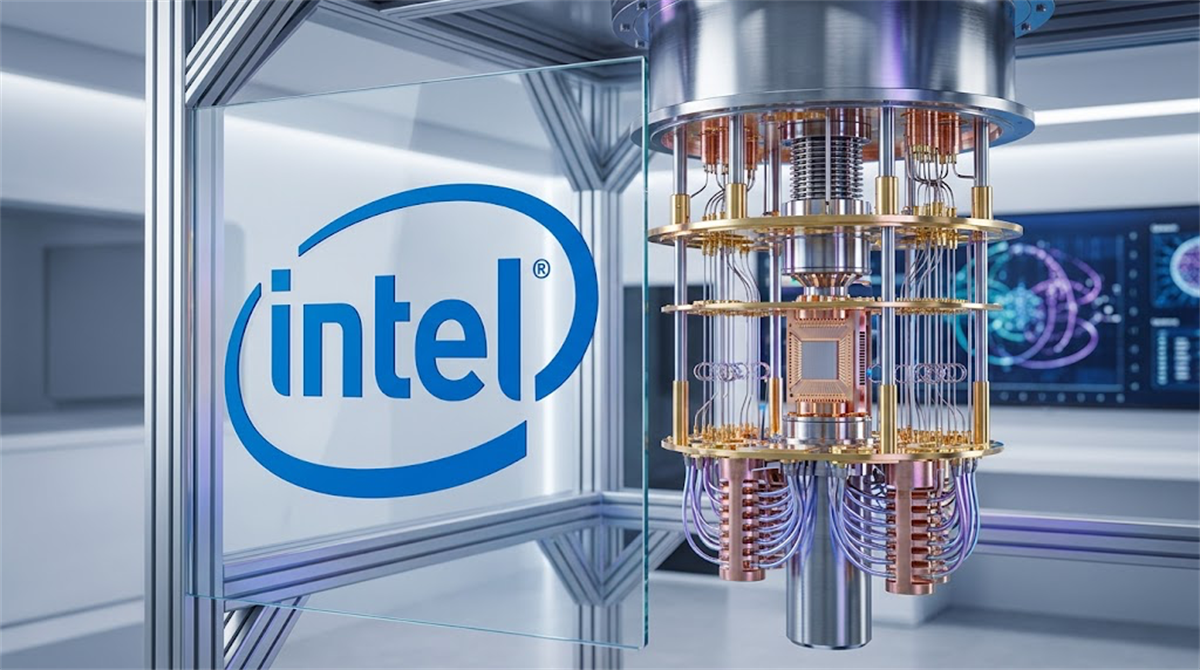
Intel adopts a unique approach to quantum—its focus is on silicon spin qubits, distinct from the superconducting qubits used by Rigetti Computing (NASDAQ: RGTI) and others, as well as from the annealing approach historically used by D-Wave Quantum Inc. (NYSE: QBTS). Intel has bet that silicon spin qubits will be easier to scale thanks to their smaller size and the company's existing manufacturing capacity to build them.
This last point is a huge advantage for Intel, which has some of the most impressive chip fabrication capabilities in the world. The firm already has massive operations up and running, building AI chips for NVIDIA and others, and if quantum chips could be built using some or all of that same infrastructure, it would be a major boon for Intel. Because Intel's Foundry business—which makes chips for other companies in Intel's fabs—posted a sizable operating loss of $2.4 billion in the latest quarter, this development could be transformative.
CHIPS, Apple, and NVIDIA Have Benefits for Quantum as Well as Classical
The CHIPS Act grant and deals with Apple and NVIDIA certainly have benefits for Intel's classical computing operations, but they may also help to drive its quantum efforts. Intel will benefit from CHIPS Act support of its Ohio and Arizona fabrication operations, a crucial move that will help to reduce dilution risk and lower CapEx risk in the coming years. The result is more funds freed up for new pursuits, including quantum.
The Apple foundry deal positions Intel at an advantage over pure-play quantum firms if indeed its silicon spin qubits can be built using some of the same infrastructure as Intel's other chips, while the NVIDIA equity stake may help to accelerate the integration of Intel's quantum technology with NVIDIA AI compute architecture in the coming years.
One download, yours for good (Ad)
Simple Options Trading For Beginners is currently available as a free download - a guide normally priced at $29.97 that explains options in plain English with no jargon and no Greeks.
Once the file lands on your machine, your copy is yours permanently, regardless of what the price does after the window closes. This offer won't stay open indefinitely.
Download your free copy of Simple Options Trading For Beginners now
Pure-Play Quantum Firms Have a Valuation Disconnect, But Don't Discount Them
Taking Rigetti and D-Wave as two of the leading pure-play quantum firms, a major sticking point for investors interested in these companies is valuation. Rigetti's $4.4 million in Q1 2026 revenue is difficult to reconcile against a market capitalization of over $7 billion unless the company can seamlessly pivot to a commercially viable model. D-Wave's commercial momentum is strong, but there is a similar disconnect between valuation and sales, and being a pre-profit company does not help either.
Nonetheless, these and other pure-play companies do have advantages, even over major players like Intel. In Rigetti's case, its gate-model approach seems to hold significant technological potential as a path toward fault-tolerant quantum systems (just look at similar approaches by other legacy tech players for confirmation). Implementing this technology remains a hurdle, but Rigetti's approach seems viable.
D-Wave has a key benefit in its recurring subscription revenue and customers in the enterprise space. With its singular focus on quantum, a company like this may be able to carve out a niche even when competing against a bigger name like Intel if the latter company's research interests become too diffuse.
All that said, pure-play quantum firms may be analyst darlings but still represent speculative investments. Investors with a high tolerance for risk and a conviction that quantum computing will transform in the coming decade may be willing to buy and hold these stocks. Certainly, if Intel and its peers shift their priorities away from quantum in the coming years, smaller players like Rigetti and D-Wave would gain another advantage. However, signs seem to be pointing to the opposite, which may be good for investors keen to see quantum tech advance but less so for pure-play firms.
Further Reading
- The J.M. Smucker Company’s Dividend: Too Sweet to Ignore?
- ALERT: Drop these 5 stocks before the market opens tomorrow! (From Weiss Ratings)
- From Crypto to AI: Insiders Are Trading These 3 Stocks
- Goldman Sachs just told you what to buy (most people missed it) (From Behind the Markets)
- Apple's Siri AI Was Finally Announced, So Why Is the Stock Tanking?
- Has Temu-Owner PDD's Story Changed After Double Miss?
- Tanker Dividends Are Surging, But Income Investors Need to Watch the Cycle
Stay Ahead of the Market
The best investment opportunities don't wait. Get our research and stock ideas delivered straight to your smartphone—so you never miss a market-moving opportunity. Our text alerts ensure you see timely stock ideas and professional research reports instantly, whether you're in a meeting, commuting, or away from your desk.
