
The REAL Reason Trump is Invading Iran (From Banyan Hill Publishing)
Key Points
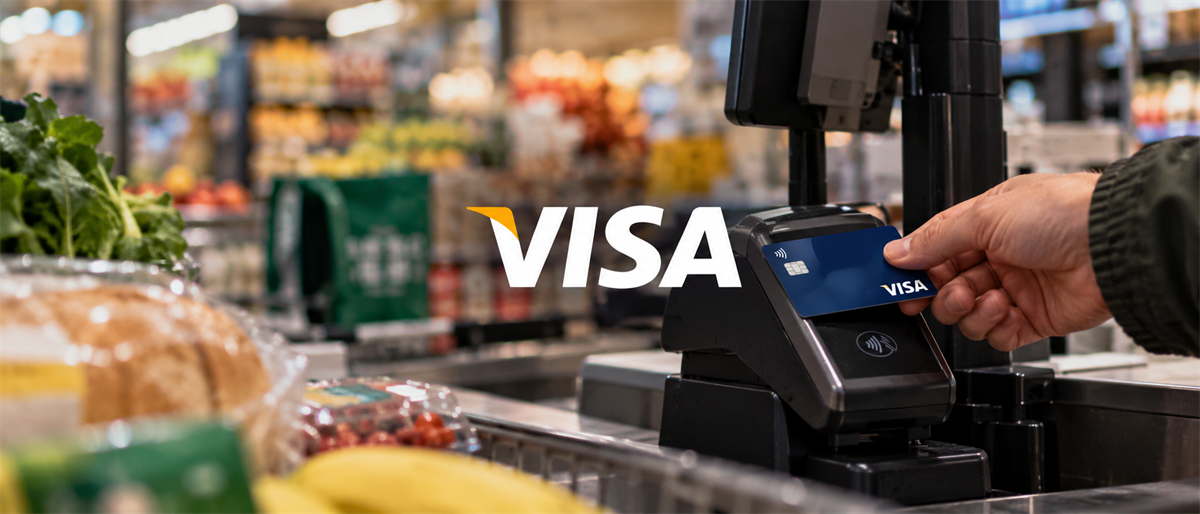
- Visa shares have climbed to fresh all-time highs above $405, up 16% year to date, as investors rotate from high-beta technology stocks into defensive payment networks.
- Visa launched an autonomous AI agent commercial payments pilot with BILL Holdings and Billtrust to automate business-to-business invoice settlements and expand beyond consumer cards.
- Visa reports fourth-quarter earnings on Oct. 27, with consensus estimates near $3.42 per share, and the company typically announces its annual dividend increase alongside that release.
- Special Report: A new income category is drawing serious money - here's why (From Investors Alley)
Investors tracking the recent rotation out of high-beta technology sector stocks are finding a familiar haven in global payment networks.
Trading near fresh all-time highs above $405, Visa Inc. (NYSE: V) is capitalizing on an institutional pivot toward defensive, inflation-resistant cash generators.
The global payment processor is expanding its traditional retail moat by launching a commercial payments pilot with BILL Holdings Inc. (NYSE: BILL) and Billtrust, using autonomous AI agents.
The move signals that Visa's high-margin business is evolving beyond consumer cards to capture high-ticket, business-to-business enterprise flows.
Trump goes "all-in" on Grand Canyon energy breakthrough (Ad)
A drilling crew near the Grand Canyon uncovered a clean energy well producing nearly eight times the output of Saudi Arabia's largest oil field, with potential to last two million years.
While the One Big Beautiful Bill Act eliminated federal credits for solar, wind, and EVs, this energy source was reclassified alongside oil and nuclear power and given eight years of tax credits. Google signed a 15-year contract, and Bill Gates committed $100 million.
One company controls the entire supply chain behind this discovery.
See the ticker behind this Grand Canyon energy breakthrough now
Swiping Away Volatility: Visa's Defensive Breakout
In recent weeks, asset allocators have started rotating capital out of the high-multiple semiconductor sector and hardware technology equities. That capital is finding a home in capital-efficient financial infrastructure. Visa's stock price recently broke cleanly out of its prior 50-day trading range, establishing fresh all-time highs approaching $409 per share. The stock has gained 16% since the start of the year, reflecting broader institutional appetite for resilient cash flow.
The appeal lies in Visa's underlying financial engine. Generating about $40 billion in annual revenue and roughly $20 billion in net income in fiscal 2025, Visa operates with a level of capital efficiency that few public organizations can match. Institutional investors often view the payment network as a defensive growth asset. Visa provides the technological routing layer for global commerce while avoiding the heavy capital expenditures required to build new physical products or carry vast inventory.
Capturing Inflation Without Balance Sheet Risk
Understanding Visa requires separating the payment network from the banking institutions that actually issue the credit cards. Visa operates a tollbooth-like payment network, generating revenue from payments volume, processed transactions, and cross-border activity rather than collecting the interchange fees paid to card-issuing banks.
When consumer prices rise at the grocery store or the gas pump due to persistent inflation, the nominal value of those transactions increases. Consequently, Visa can generate more revenue from volume-based fees without incurring proportional increases in its own operational overhead.
This structural advantage yields peer-leading profitability metrics. Visa has a pretax margin near 60% and a net profit margin just above 50%. With a return on equity exceeding 67%, the business generates healthy cash reserves from its existing assets.
More importantly, because Visa functions primarily as a technology and network rails operator, it does not originate consumer loans or bear the associated credit risk. As macroeconomic indicators point to rising consumer credit card delinquencies and broader financial stress, Visa remains shielded from the loan-loss provisions and charge-offs that typically pressure closed-loop operators like American Express (NYSE: AXP) or traditional regional banks.
Do NOT Buy SpaceX – Do This Instead (Ad)
SpaceX just went public - and Whitney Tilson, Harvard MBA and 30-year Wall Street veteran, says buying in could be a costly mistake. He calls it among the most overhyped, overvalued large-cap offerings ever pushed onto everyday investors.
Tilson believes a rare economic event is approaching - one with serious consequences for your portfolio this summer. He has prepared a free analysis outlining what he sees and the specific steps he recommends taking now.
Read Tilson's free analysis and find out what to do with your money
Automating the Ledger: Visa's Move Beyond Consumer Retail
While consumer retail spending forms the foundation of Visa's revenue, the next phase of growth targets the large, often inefficient world of business-to-business payments. On Oct. 20, Visa launched a live commercial pilot alongside BILL Holdings Inc. and Billtrust to execute end-to-end buyer-to-supplier payments driven by autonomous artificial intelligence agents.
Historically, corporate payments face significant workflow friction. Accounts payable teams often spend countless hours manually logging into supplier portals, completing security checks, and typing in payment credentials to settle invoices.
Through the Visa Intelligent Commerce portfolio and its Trusted Agent Protocol, authenticated AI agents can now programmatically fulfill approved invoice payments directly through participating supplier portals. This eliminates manual credential entry without requiring companies to share sensitive underlying login data. By modernizing these back-office workflows, Visa positions itself to capture high-ticket enterprise transactions that have traditionally been settled via paper checks or low-margin legacy clearinghouse channels.
Visa is also modernizing its cross-border money movement architecture. Visa Direct recently moved stablecoin-backed prefunding from pilot programs to commercial production with Inyo Global. By integrating stablecoin prefunding into Visa Direct, Visa allows eligible businesses to fund cross-border payouts with USDC rather than relying solely on traditional funding windows. This helps to ensure the network remains the foundational routing layer even as programmable, blockchain-adjacent liquidity becomes more common in global trade.
Swiping Through Q4: Earnings Durability Meets Valuation
Quality rarely comes cheap in the public markets, and Visa's premium valuation reflects its dominant market position. Visa trades at a trailing price-to-earnings ratio near 34x and a forward multiple of roughly 30.8x. While this represents a slight discount compared to close rival Mastercard Incorporated (NYSE: MA), it leaves a relatively narrow margin for error regarding forward guidance.
Wall Street remains optimistic, with an average 12-month consensus price target pointing toward the $426 range. Investors will look for validation of these targets during the upcoming fourth-quarter earnings release on Oct. 27, where consensus estimates suggest earnings of around $3.44 per share.
Visa traditionally uses its fourth-quarter report to announce its annual dividend increase. With the current dividend yield sitting at a modest 0.66%, Visa's operating cash flow of over $13 per share provides ample runway for a meaningful payout expansion, alongside active share repurchases that have steadily reduced the outstanding float to around 1.78 billion shares.
The regulatory landscape requires continuous monitoring. Visa plans to expand lower interchange rates for qualifying small merchants in October 2026 and introduce a new domestic transaction fee in April 2027. These changes could add to merchant pushback, while U.S. legislative proposals, particularly the Credit Card Competition Act, remain a separate concern. Escalated merchant pushback and antitrust scrutiny are ongoing macroeconomic headwinds that could cap multiple expansions over the medium term.
Long-Term Rails: Strategic Positioning for Investors
Visa offers a strong structural shelter during periods of economic uncertainty. Generating royalty-like transaction fees on global trade allows Visa to translate nominal spending growth into operating earnings expansion. The recent move into AI-driven enterprise payments demonstrates a management team actively expanding its total addressable market rather than resting on its consumer retail dominance.
Those analyzing Visa might view the current all-time highs with some caution, given the near-term earnings volatility often priced into the options chain ahead of a major quarterly report. Accumulating shares during broader market pullbacks aligns well with a strategy focused on durable, high-margin compounders. The underlying network remains an essential pillar of global financial infrastructure, uniquely positioned to benefit from both everyday consumer spending and the ongoing digitization of commercial money movement.
Recommended Stories
- Spotify Soars After Earnings as the Company Touts AI Benefits and Moderating Costs
- The Fed is stuck. Here’s what I’m doing (From Traders Agency)
- Lockheed Martin’s Record $292 Billion Backlog Comes With a Delivery Test
- What Elon Musk's Cybercab Reveal Could Mean for Investors (From Brownstone Research)
- Palantir's Next Big Test Isn't a Partnership—It's the Numbers
- Kinder Morgan's $4.7 Billion Pipeline Bet Could Be Bigger Than Its Earnings Beat
- Capital One Earnings: After a Double Beat the Rally Is On

Stay Ahead of the Market
The best investment opportunities don't wait. Get our research and stock ideas delivered straight to your smartphone—so you never miss a market-moving opportunity. Our text alerts ensure you see timely stock ideas and professional research reports instantly, whether you're in a meeting, commuting, or away from your desk.
