
Record Revenue Gold Silver Royalty Firm Still Trades Below 1 Dollar (From Digest Publishing)

Key Points
- Charles Schwab reported that its clients were net sellers of Palantir stock in August, even as shares subsequently rallied.
- Institutional investors hold approximately 46% of Palantir shares, while several Wall Street analysts have recently upgraded the stock or raised their price targets.
- Palantir's ambitious free-cash-flow outlook and growing sovereign AI business could influence investor sentiment ahead of third-quarter earnings.
- Special Report: The investigation Porter spent tens of thousands to document (From Porter & Company)
Are retail investors bailing on Palantir Technologies (NASDAQ: PLTR)? At least one group of shareholders was selling. In its August 2026 Schwab Trading Activity Index report, Charles Schwab reported that PLTR was one of several high-beta technology stocks that its clients net sold.
The top-of-mind question is why? Schwab cites profit-taking and rotation within the tech sector as two reasons for the selling. That holds up, given that names like SpaceX (NASDAQ: SPCX), Micron Technology (NASDAQ: MU), and Intel Corp. (NASDAQ: INTC) were among those that saw net buying during the month.
PLTR has gained more than 50% over the past three months. That means somebody has to be doing the buying. In this case, it appears that institutions are finally sending a signal that it's time to dive in.
100% overnight gains? (Ad)
Rumors are circulating that Elon Musk is preparing to acquire three publicly traded companies.
Dr. Mark Skousen, who met Musk in person and called the SpaceX listing months early, says he has identified all three targets in what he calls Elon's $2.1 Trillion Hit List.
See the three companies before the rumors become headlines.
Get the details on all three companies now
Wall Street Is Playing Catch-Up
Over the past three months, the consensus price target from the analysts tracked by MarketBeat has risen from $190.85 to $201.61, compared with $194.04 a month ago. That's an increase of nearly 6%, but PLTR's share price has climbed much faster. With shares trading near $200, the consensus target now implies little additional upside.
Here's where the story gets better. Institutional ownership in PLTR is still around 45%. That compares with roughly 80% for Micron and about 64% for Intel, two of the stocks Schwab clients were buying. That gap leaves plenty of room for fund managers to build positions, although it doesn't guarantee they will.
Retail investors drove a strong move in Palantir. But it's institutional money that will likely be the catalyst for the next leg higher. MarketBeat's institutional ownership data shows more institutional buyers than sellers over the past year, while recent analyst activity suggests improving sentiment.
In October alone, Goldman Sachs upgraded PLTR from Neutral to Buy with a $230 price target. Raymond James upgraded the stock from a Hold to a Moderate Buy. Barclays initiated coverage with an Overweight rating and a $265 price target. And Robert W. Baird also set a fresh price target of $250 on PLTR.
A $250 price target would imply roughly 25% upside from recent trading levels. While that is well above the current consensus, it reflects the more bullish outlook emerging among some Wall Street analysts.
Karp's Ambitious Free Cash Flow Forecast
The growing optimism follows the company's blowout Q2 2026 earnings report in August. The headline numbers comfortably beat expectations; Palantir is showing strong growth in both the commercial and government sides of its business.
But one of the most ambitious projections came earlier, during a July 1 CNBC interview. That's when CEO Alex Karp said Palantir could generate $15 billion to $18 billion in free cash flow within two years.
It's important to put that in perspective. For the full year 2026, the company is forecasting adjusted FCF between $4.5 billion and $4.7 billion. Achieving Karp's bullish forecast will require FCF to grow by roughly 80% to 100% annually.
Before dismissing that kind of growth, remember that Palantir delivered adjusted FCF growth of 115% in the second quarter. Plus, Karp has a track record of delivering on forecasts that skeptics dismissed as talking his book.
Nvidia pours 7 billion into a light speed AI breakthrough (Ad)
Nvidia has invested more than 7 billion dollars into a light speed device that could reshape how AI systems operate.
Bill Gates put in over 200 million of his own money, while BlackRock, Vanguard, Morgan Stanley and Norway's sovereign wealth fund are positioning around it. Related stocks have already climbed 133 percent, 217 percent and 320 percent.
Wall Street analyst Jason Bodner, who called Nvidia at 4.50, is sharing his top pick tied to this trend at no cost.
Click here to see Jason Bodner's free AI stock pick
Sovereign AI Gives Institutions a Story to Underwrite
The company is also getting a boost as the concept of sovereign AI has become front-and-center in the AI trade. The real story here goes back to institutional interest. The issue of sovereign AI has been an "aha moment" that has crystallized Palantir's one-of-one role in the AI stack.
Sovereign AI refers to nations building AI capabilities they control, from the data to the models to the software that runs on top of them. For governments, that’s a matter of national security. Few software companies have Palantir’s decades of experience operating inside classified environments. Recent partnerships, including a sovereign AI push with edge-computing company Armada, reinforce that position.
For institutional investors, that matters. It’s easier to justify a premium multiple for a company with a defensible moat than for a stock riding an AI narrative.
What the Chart Says Ahead of Earnings
The Oct. 14 session was a reminder that the handoff won’t be smooth. PLTR fell about 4% after briefly trading above $209, giving back its break above the November 2025 record high near $207.50. But the selling came on relatively light volume, and buyers stepped in right at the $200 level.
The 50-day simple moving average, now around $181, is rising steeply but sits roughly 10% below the current price. That shows how extended the move has become. The MACD remains above its signal line, but the histogram has started to narrow, which suggests momentum is cooling rather than reversing.
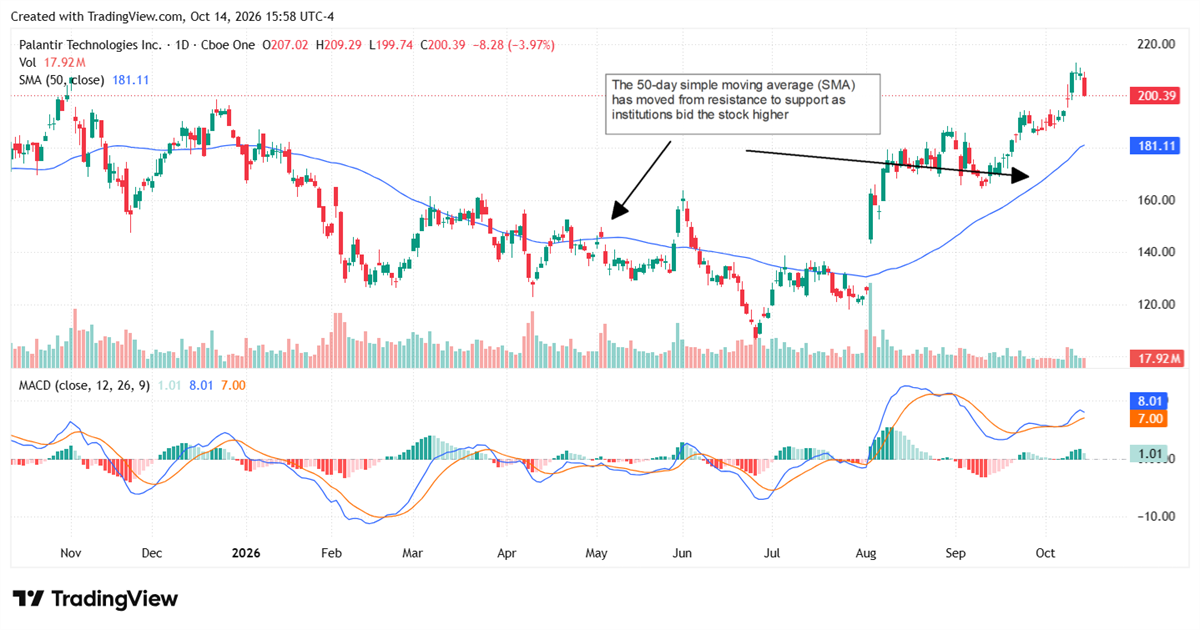
Palantir is expected to report Q3 results in early November. If institutions are truly stepping in, dips toward $200, or even the 50-day average, should attract buyers rather than trigger an exodus. Retail investors who sold in August may have locked in solid gains. The question is whether they left the next leg of the move on the table for Wall Street.
Read More
- Bank of America Stock Sell-Off Looks Like a Buying Opportunity
- Why most people ignore my “boring” stock picks (From Monument Traders Alliance)
- AST SpaceMobile Is Down 67%—Could SpaceX's Mobile Push Deepen the Selloff?
- Elon Musk’s 4th Wealth Window Set to Open by October 30 (From Brownstone Research)
- GlobalFoundries' $21 Billion Deal Could Change the Economics of Chipmaking
- Fundamental and Technicals Signals Align for Costco: Is the Stock Finally Breaking Out?
- Morgan Stanley Beats on Earnings, But Shares Fall on Trading Mix

Stay Ahead of the Market
The best investment opportunities don't wait. Get our research and stock ideas delivered straight to your smartphone—so you never miss a market-moving opportunity. Our text alerts ensure you see timely stock ideas and professional research reports instantly, whether you're in a meeting, commuting, or away from your desk.
