
What really happened in Beijing? (From Porter & Company)
Key Points
- Waste management companies are using AI to automate operations, optimize routes, and improve profitability.
- Waste Management and Republic Services are investing heavily in AI-driven recycling and fleet management initiatives.
- Casella Waste offers investors a smaller-cap opportunity tied to AI adoption and operational efficiency gains.
- Special Report: Ray Dalio: Buy Gold. Get Paid. (From Investors Alley)
The debate over artificial intelligence has centered on one thing: the cost of the infrastructure needed to support it. That focus may be missing the point. A wider lens shifts attention to the companies already using AI to run their businesses more efficiently.
The key point to remember is that AI isn’t a one-time investment. The savings it delivers depend on an ongoing commitment—one far smaller than the CapEx hyperscalers are pouring into data centers, but far more durable. These investments aren't going away, and they will grow.
So while many investors focus on data centers, others are pocketing profits by investing in companies already using AI to make their businesses more efficient.
An overlooked sector is waste management. Companies in this industry are investing billions of dollars into AI strategies that are helping to expand margins. The sector is a perfect example of investments being made in AI today that are a down payment for a more efficient future.
Problems at SpaceX: time to get out? (Ad)
Goldman Sachs and Morgan Stanley are now predicting what could be the worst news for the U.S. stock market in 50 years - and it has nothing to do with a single stock.
According to multiple Wall Street banks, a coming crisis could keep your portfolio in the red for 10 years or longer. Keith Kaplan, CEO of TradeSmith, is sharing what you can do to protect your wealth before it hits.
Learn how to prepare your portfolio for what's coming next
Why AI Is Becoming a Growth Driver in Waste Management
According to Grand View Research, the global AI-in-waste-management market was valued at $43.2 billion in 2025. That's projected to grow to $52.4 billion this year and then to $216.4 billion by 2033. That’s a compound annual growth rate of 22.5% between now and 2033.
Currently, AI systems enable automated sorting, route optimization, and real-time monitoring to manage rising loads more efficiently.
Waste Management Leads the Industry’s Automation Push
Waste Management (NYSE: WM) is the most aggressive AI spender among the major haulers. The company committed over $1.4 billion between 2022 and 2026 to automate its Materials Recovery Facilities. The stated goal is bold: 90% of recycling facilities automated by 2027.
But the early results justify that level of spending. Recycling EBITDA grew 22% in 2025, even as commodity prices fell 20%. That's a company showing how to convert AI CapEx into shareholder returns.
Technically, WM shows a clean setup. Shares trade around $223, holding above the 200-week SMA of $198.
The stock bounced sharply off $200 support earlier this spring. The long-term uptrend from 2022 lows remains intact.
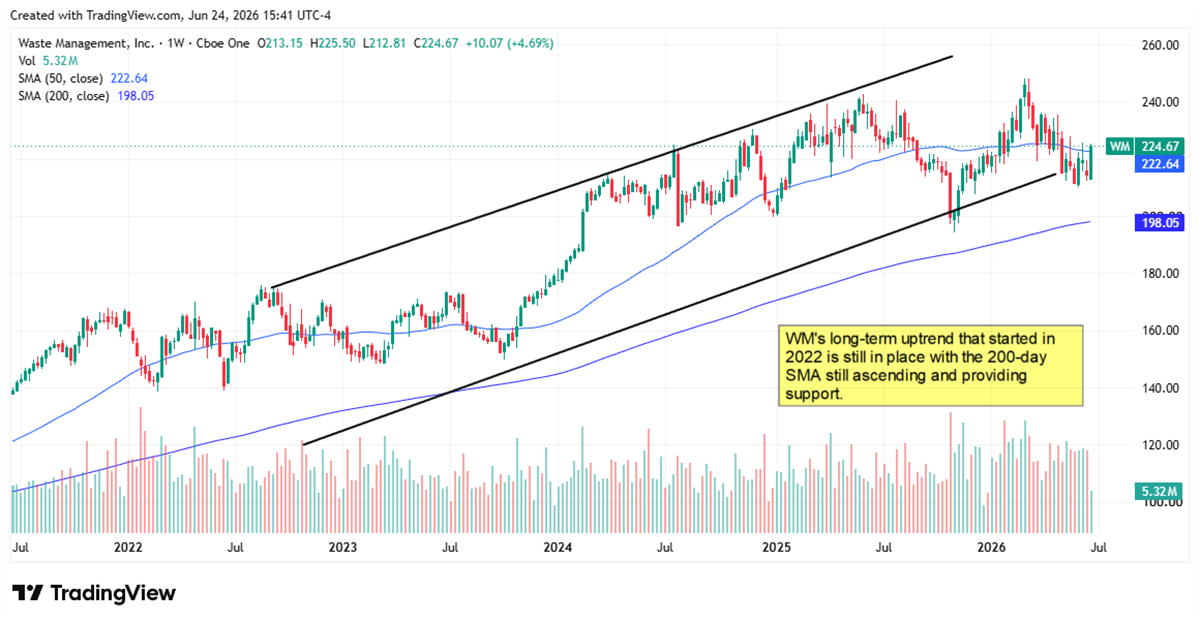
The risk is in the stock’s valuation. WM trades around 27x forward earnings, leaving little room for execution stumbles. Investors are paying a market multiple for the AI-disruption-proof narrative. The company must keep delivering margin gains to justify it.
Three oil giants buried the same discovery for 50 years (Ad)
In 1976, Chevron, Unocal, and Texaco each confirmed the same energy technology worked - no fuel costs, no carbon, no supply chain. All three killed their projects because it threatened their core business.
Now one company has spent sixty years developing what Big Oil refused to touch. Google just signed a 15-year contract, Bill Gates wrote a $100 million check, and on July 4th the government hands it a competitive edge no other energy source receives.
See the company that spent 60 years perfecting what Big Oil buried
Republic Services Balances AI Investments and Dividend Growth
Republic Services (NYSE: RSG) is the number two hauler by revenue, and like Waste Management, investors should pay attention to the valuation. RSG trades at roughly 29x 2026 earnings estimates. That valuation bakes in continued margin expansion from automation.
RSG previewed its expanded AI strategy at the June 2026 Inaugural Waste Leadership Summit. The company is rolling out upgraded MRFs across its footprint, including an April opening in Peabody, Massachusetts. Investments target sorting accuracy, fleet routing, and dynamic pricing models.
The technical setup is less encouraging. Shares recently closed at $213.71, below the 50-week SMA of about $218.84. The stock peaked near $232 in early 2026 and has trended lower since. The 200-week SMA at $187.80 marks the next major support zone.
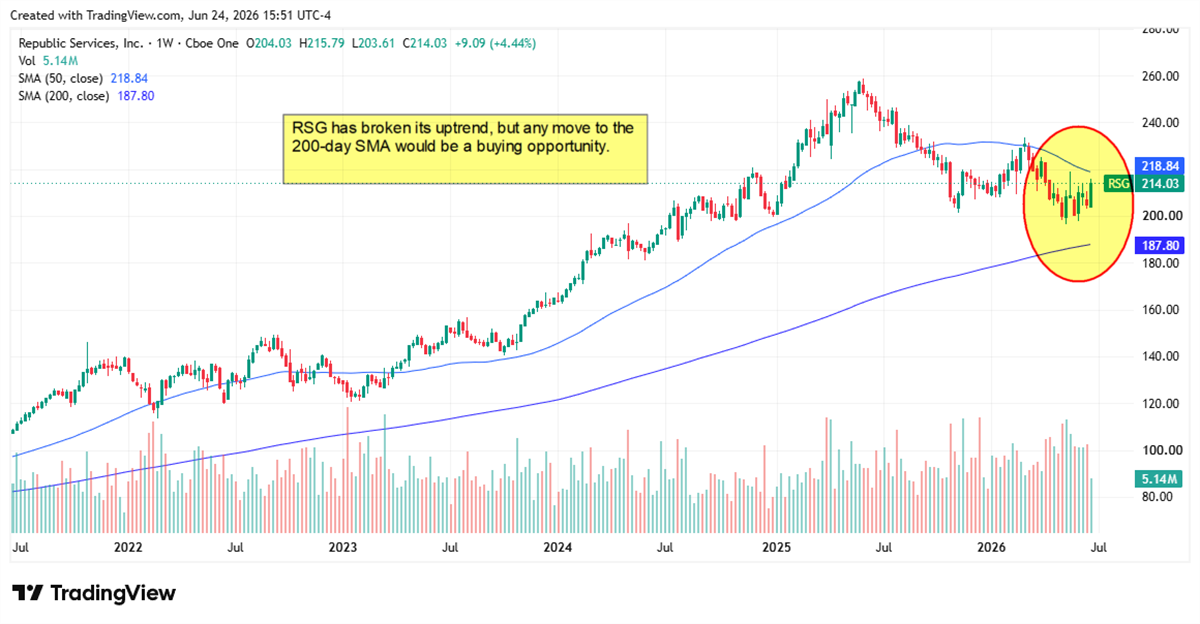
But with 22 consecutive years of dividend increases, RSG remains a high-quality compounder with defensive characteristics. The company’s pricing power makes that dividend growth secure. But the chart suggests patience may be rewarded. A breakout above the 50-week average would signal buyers are returning with conviction.
Casella Waste Systems Offers a Contrarian AI Opportunity
Casella Waste Systems (NASDAQ: CWST) is the small player in this group with a market cap of just over $5 billion. The company’s regional footprint is concentrated in the Northeast and is taking a measured approach to AI. CEO Ned Coletta has emphasized integrating AI alongside existing routing tools, particularly after acquisitions.
Early use cases include real-time driver coaching and route automation across newly acquired territories. That's a different playbook than WM's facility-wide overhaul.
It fits Casella's roll-up strategy, where bolt-on deals need fast technology integration to capture synergies.
The chart tells a contrarian story. CWST trades around $92, below the 50-week SMA of $92.93 and the 200-week SMA of $93.40. Shares fell from $120 highs in late 2025 to lows near $75 earlier this year.
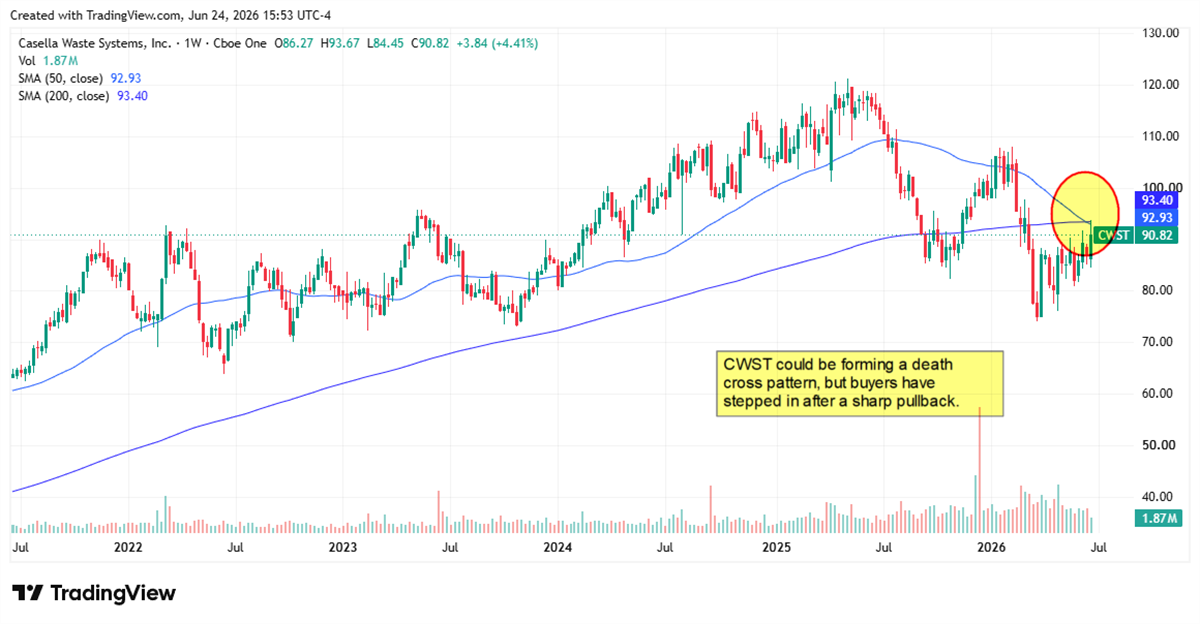
The technical setup carries real risk. A close below recent lows would invite further selling. But the pullback resets the valuation for investors comfortable with smaller, acquisition-driven names.
Featured Articles
- 3 Stocks That Could Benefit as the Robotaxi Race Heats Up
- Missed Nvidia’s 44,000%? This is the next big opportunity (From InvestorPlace)
- 3 Overlooked Tech ETFs That Are Quietly Killing It This Year
- The $15 Gold Fund That Pays Up to $1,152/Month (From Investors Alley)
- 3 ETFs Pairing Market-Beating Returns With High Dividend Yields
- MarketBeat Week in Review – 06/22 - 06/26
- Rocket Lab's NASA Win Tests Key Support After Sharp Pullback
Stay Ahead of the Market
The best investment opportunities don't wait. Get our research and stock ideas delivered straight to your smartphone—so you never miss a market-moving opportunity. Our text alerts ensure you see timely stock ideas and professional research reports instantly, whether you're in a meeting, commuting, or away from your desk.
