
Don’t Buy SPCX Until You Read This (From Porter & Company)

Key Points
- Microsoft is routing some Excel and Outlook prompts to its own MAI models instead of OpenAI or Anthropic to cut costs and improve margins.
- Microsoft is hedging its AI dependency through a three-way approach involving OpenAI, Anthropic's Claude, and its own in-house MAI models.
- Despite falling about 20% year-to-date, MSFT trades near 22 times forward earnings with a bullish analyst consensus and a price target well above its current level.
- Special Report: Is the America you planned on retiring in, slipping away? (From American Hartford Gold)
Microsoft Corp. (NASDAQ: MSFT) has taken steps to lessen its reliance on frontier AI models, though it's not an outright declaration of protest. In June, the tech giant launched its own proprietary AI models (Microsoft AI or MAI) across select applications in its Office suite.
What this means for the user experience is an open question, but this is a clear margin play for Microsoft. The company competes in multiple areas of the AI infrastructure buildout. In a way that makes this move about controlling the controllables.
Instead of experiencing death by a thousand cuts from OpenAI and Anthropic (i.e., the frontier models), Microsoft is trying to widen its existing moat and deliver strong returns on investment (ROI) from its AI spend. But will this be sufficient to alter the sentiment towards MSFT, which has declined approximately 20% year-to-date?
I endorsed someone else's model for the first time (Ad)
Porter Stansberry spent 30 years ignoring outside investment systems - until he met Emmet Savage in Dublin. Savage's model, built on Hamiltonian mechanics applied to equity analysis, has delivered nearly 2,000% returns over 17 years with only one losing year.
What convinced Porter wasn't the returns. It was the sell discipline - a framework that identifies the exact moment a position's energy begins to decay, signaling an exit before the decline. He calls it the most rigorous sell system he has ever seen, comparing its edge to RenTech's famed Medallion Fund.
Watch Porter's full breakdown of Project Prophet and Emmet's system
Microsoft Expands MAI to Reduce Reliance on OpenAI
Here's the news behind the news. Bloomberg reported that Microsoft is quietly routing some Excel and Outlook prompts to MAI, its in-house model family, rather than to OpenAI or Anthropic. Tens of thousands of prompts a week are already running on Microsoft's own tech.
That's still a small slice of total Copilot traffic. OpenAI and Anthropic handle most of it today. But the direction of that travel matters more than the current split, and Microsoft has made its intentions clear.
At Build 2026 in June, Microsoft unveiled seven MAI models, including its first reasoning model, MAI-Thinking-1. The company says it matches Anthropic's Claude Opus 4.6 on coding tasks. AI chief Mustafa Suleyman put it bluntly: "We pay a lot of money to Anthropic, so our goal is to reduce and ultimately eliminate that cost."
How Microsoft's In-House AI Could Boost Profit Margins
For investors, an easy way to think about this is as follows. Copilot is a $30-per-seat subscription that, prior to the MAI launch, was running on top of someone else's expensive AI model by default. Every prompt costs Microsoft money to process, and multiplied across hundreds of millions of Office users, that bill adds up fast.
Owning the model instead of renting it changes the equation entirely. Microsoft doesn't need MAI to win over every customer. It just needs MAI to be good enough for everyday spreadsheet formulas and email drafts, at a fraction of the cost.
That's the ROI story. Microsoft won’t win an AI arms race on raw intelligence. But it can compete more efficiently by converting a rented cost center into owned infrastructure.
He bet half his $9 billion on ONE stock (Ad)
One of the most successful fund managers of the past 50 years put more than half of his $9 billion portfolio - roughly $4.5 billion - into a single little-known company. Then his firm bought more shares for 61 straight trading days.
The former CEO of Google followed with a nine-figure partnership. The White House invoked emergency powers to protect what this company controls. A July 13th deadline could trigger a flood of institutional buying. Whitney Tilson, who called Netflix at 78 cents and Apple at 38 cents, is giving away the name and ticker free.
Watch the free presentation and get the ticker before July 13th
Microsoft Uses MAI to Strengthen Its AI Competitive Moat
Microsoft chief executive officer (CEO) Satya Nadella has reportedly said he feared Microsoft becoming "the next IBM.” By that, he meant a company that let someone else own the most important layer of technology. MAI is Microsoft's answer to that fear.
Instead of a single point of AI dependency, Microsoft now runs a three-way hedge. It holds a stake in OpenAI, embeds Anthropic's Claude in Copilot, and increasingly leans on its own models where the economics make sense. That flexibility is arguably a bigger moat than any one model's benchmark score.
It also insulates Microsoft from a ticking clock. Microsoft's current discounted OpenAI pricing won't last forever, and that deal isn't set to expire until 2032. Building a credible in-house alternative now gives Microsoft leverage in any future renegotiation, rather than leaving it stuck paying whatever OpenAI or Anthropic decides to charge.
The Bear Case: Risks to Microsoft's AI Strategy
Before getting too bullish, a few caveats are worth weighing. This shift is still incremental, and Microsoft hasn't published any timeline for expanding it further. Most Copilot workloads still run on outside models today.
There's also a quality question. Microsoft's own materials frame MAI as matching prior-generation Anthropic models, not necessarily the current large language models (LLMs). If MAI-powered features feel noticeably worse, customer goodwill could take a hit that outweighs the cost savings.
What It Means for OpenAI and Anthropic
This is a warning shot worth watching. Anthropic filed confidentially for an IPO in June, and OpenAI is reportedly preparing a similar filing. Their biggest enterprise distribution partner is now also a competitor, building cheaper in-house alternatives.
That doesn't mean OpenAI or Anthropic are in immediate trouble. Both still handle the bulk of Copilot's AI traffic, and Microsoft has made it clear that it isn't ending either partnership. But the "picks and shovels" trade just got a little more complicated for anyone betting purely on third-party AI labs staying indispensable.
Microsoft Stock Rebounds After Hitting a 52-Week Low
Microsoft hit a 52-week low in late June. The 10% bounce off that level isn’t a sign that everything is perfect, but it does suggest that investors are leaning into the stock’s value proposition.
At around 22x forward earnings, Microsoft is trading at a discount to the S&P 500 and to its own history. An argument could be made that MSFT wasn’t overvalued when the sell-off began in November, and there’s ample reason to believe it’s undervalued now. The relative strength indicator reached oversold territory when MSFT bottomed in June.
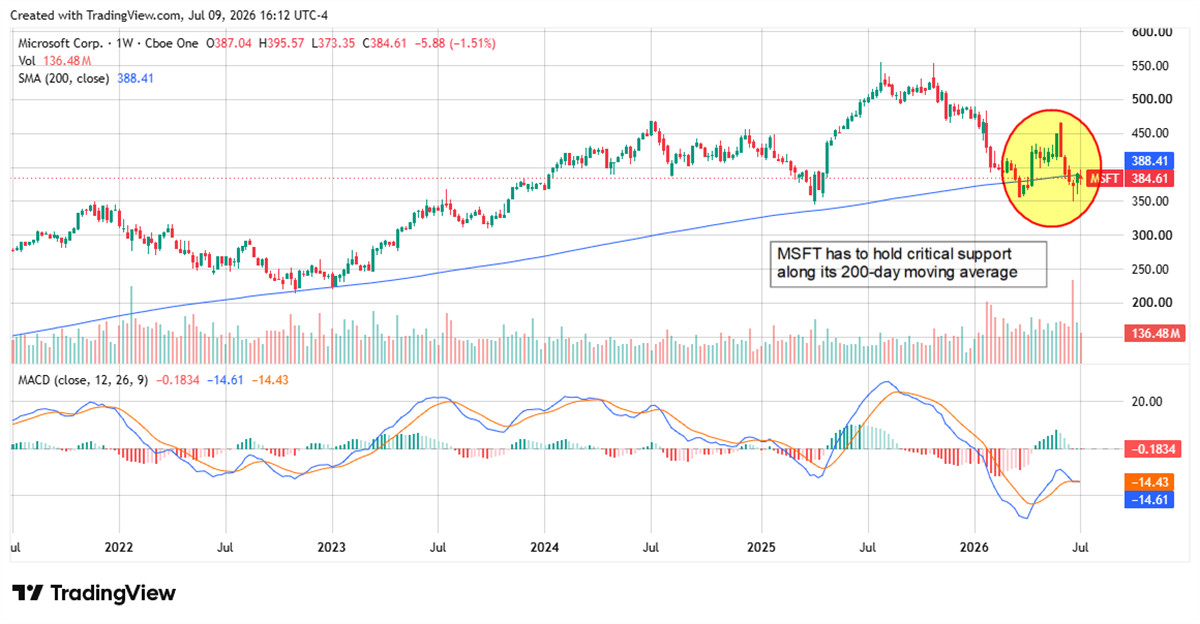
But a larger story comes from analysts and institutions. The MSFT consensus price target of $559.84 is approximately 45% below its recent trading range. Plus, out of 48 analysts tracked by MarketBeat, 41 give MSFT a Buy rating, and seven rate it as a Hold. Analysts notoriously don’t like to be wrong, which may explain why some analysts have trimmed their price targets, but the overall sentiment remains bullish.
The same cautious optimism can be found in its institutional ownership. There's no question that buying has slowed in the first two quarters of the year. But buying still outpaces selling, and with MSFT at 22x earnings, this could be an attractive target for money that hasn’t left the market and is looking for growth in the second half.
Featured Stories
- 3 Rare-Earth ETFs That Help Investors Balance Exposure and Risk
- ALERT: Drop these 5 stocks before the market opens tomorrow! (From Weiss Ratings)
- Delta Air Lines Lives Up to Its Claims: Shares Can Keep Climbing
- Ray Dalio: Buy Gold. Get Paid. (From Investors Alley)
- This Dividend ETF Choice Could Shape Your Income Strategy Through 2026
- Why "Big Short" Investor Michael Burry Sees Upside in Beaten-Down Sportbook Stocks
- Starbucks Builds Sovereign AI to Cut $400 Million in Software Costs
Stay Ahead of the Market
The best investment opportunities don't wait. Get our research and stock ideas delivered straight to your smartphone—so you never miss a market-moving opportunity. Our text alerts ensure you see timely stock ideas and professional research reports instantly, whether you're in a meeting, commuting, or away from your desk.
