
In partnership with

Someone just spent $236,000,000 on a painting. Here’s why it matters for your wallet.

Late last year, a Klimt sold for the highest price ever paid for modern art at auction.
An outlier sure, but it wasn't a fluke. U.S. auction sales grew 23.1% in 2025. The $1-5mm segment even grew 40.8% YoY.
Now, the S&P, teetering on all time highs, just posted its worst quarter since 2022, oil was up 94% (briefly), and Moody's puts recession odds at 48.6%.
Each environment is unique, but after dot-com, post war and contemporary art grew about 24% annually for a decade. After 2008, about 11% for 12 years.
It’s also had near-zero correlation with the S&P 500 since ‘95.*
Now, Masterworks lets you invest in shares of artworks featuring legends like Banksy, Basquiat, and Picasso.
$1.3 billion invested across over 500 artworks.
28 sales to date.
Net annualized returns on sold works held 12 months+ like 14.6%, 17.6%, and 17.8%.
Shares can sell quickly, but my subscribers can skip the waitlist:
*Investing involves risk. Past performance is not indicative of future returns. See important Reg A disclosures at masterworks.com/cd.
Just $5 - AI Stock Is Turning Heads (Here’s Why) (From Traders Agency)

Key Points
- GPU rental pricing is surging as capacity limits cap supply, and demand continues to grow.
- GPU-as-a-Service providers are well-positioned in this environment, but are not the only ones to benefit.
- GPU and memory makers are also poised to see their revenue and earnings spike.
- Special Report: Sell 99% of Your Stocks, Do THIS Instead… (From The Oxford Club)
AI bubble or not, demand trends suggest this bubble continues to grow and has no end in sight. The news in early April is that GPU rental prices are skyrocketing, and underpinning a robust outlook for GPU-as-a-Service providers. The group spans a diverse array of businesses with one thing in common: they all own or have access to NVIDIA (NASDAQ: NVDA) AI-capable GPU clusters at scale, rent them out on an on-demand or long-term basis, and benefit from a dynamic pricing model.
Dynamic pricing, in this case, simply means that demand and supply vectors align in a way that drives pricing power. Pricing power for investors means an enhanced revenue and earnings outlook, factors that drive stock prices higher. As it stands, reports show H100 and H200 pricing increasing by 40% as of March, and pricing for newer Blackwell and upcoming Vera Rubin models rising by 50% or more as of April. Demand is so high, operators are starting to turn away short-term on-demand business in favor of longer-term, highly visible contracts that enable them to leverage capital markets, invest in growth, and expand.
The REAL Reason Trump is Invading Iran (Ad)
For a moment…
Forget about Trump’s ties to Israel.
Forget about reports of Iran’s nuclear program.
Because my research has led me to believe we’re risking World War 3 with Iran for a completely different reason.
Click here to find out what it is.
And demand is there. Reports also include delayed plans from major AI labs and hyperscalers. A lack of capacity underpins their decisions, in turn driving a robust outlook for the data center, GPUs, and the GPU-as-a-Service industry. The primary delays are in training. Persistent capacity shortages linked to inference impair the training of large models. Shortages are likely to continue for the foreseeable future, as HBM memory is the heart of the problem. HBM memory is critical to AI GPU construction, with each GPU requiring numerous stacks and each HBM stack utilizing numerous chips. As it stands, HBM capacity is ramping but is not expected to significantly improve the scenario until well into 2027.
Play #1: Memory Chip Makers
Memory is at the heart of the GPU shortage, and Micron (NASDAQ: MU) is among the best-positioned. Not only are its HBM modules considered top-tier, if not the best, for AI modeling and inference, but it is well along with its expansion plans. The company has several projects underway to improve its supply chain while bolstering its domestic footprint, many of which are expected to come online in 2027 and subsequent years. Until then, revenue and earnings are growing at a high triple-digit pace, accelerating, and estimates are rising. The forecasts are underpinned by shortages, with Micron reportedly sold out of HBM through 2027, and higher pricing.
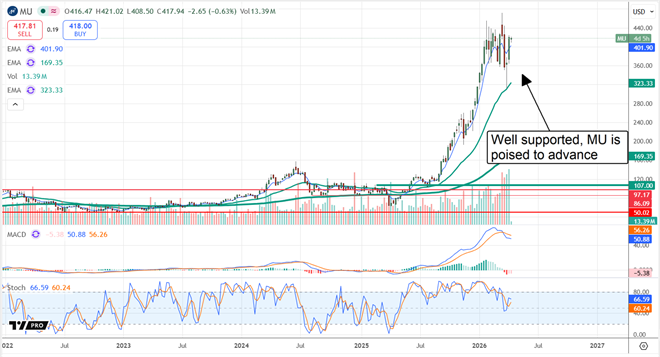
Micron’s analyst sentiment trends are robust. MarketBeat tracks 37, sufficient for a high-conviction rating; coverage has been increasing, and they peg the stock at Buy. The Buy-side bias also reflects conviction, with 90% of the ratings pegged at Buy or higher. The consensus price target assumed only 10% upside as of mid-April, but the trend remains robust, with the most recent targets suggesting at least 20% upside from the critical resistance at $450.
Play #2: GPU Chip Makers (That Aren’t NVIDIA)
NVIDIA is well-positioned to ramp production and claim revenue, but it may not be the best choice. While Advanced Micro Devices’ (NASDAQ: AMD) capabilities have lagged NVIDIA’s, it is on the brink of launching a new line, including rack-scale solutions and the software stack to run them.
AMD’s open-sourced system is designed to compete directly with NVIDIA’s CUDA, setting the stage for it to take data center share. Because its chips are viewed as better for inference and expected to provide considerable cost savings, AMD stands to sell out of its products quickly, with the impact spilling over into and boosting the data center and GPU-as-a-Service market in the longer term.
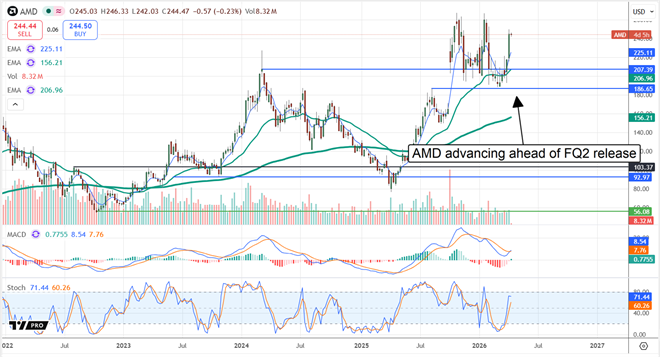
Companies with deals for MI450 products announced include Meta Platforms (NASDAQ: META), OpenAI, and Oracle (NASDAQ: ORCL). Each intends to use the GPUs to power high-capacity, high-power computing centers for AI development and inference. Analysts are bullish on the outlook, expecting revenue growth to accelerate sequentially over the next four to six quarters, and are lifting stock price targets ahead of the fiscal Q2 2026 earnings release. MarketBeat data shows 40 analysts covering AMD, a Moderate Buy consensus, and a potential 20% to 55% upside.
Play #3: GPU-as-a-Service Providers
GPU-as-a-Service providers are clear winners, with pricing that drives revenue and earnings. Names like CoreWeave (NASDAQ: CRWV), Applied Digital (NASDAQ: APLD), Nebius Group (NASDAQ: NBIS), and IREN Limited (NASDAQ: IREN) all qualify, though each has unique properties. CoreWeave may be the best-positioned, with more than 30 data centers in operation across the EU and U.S., but the others also stand to win.
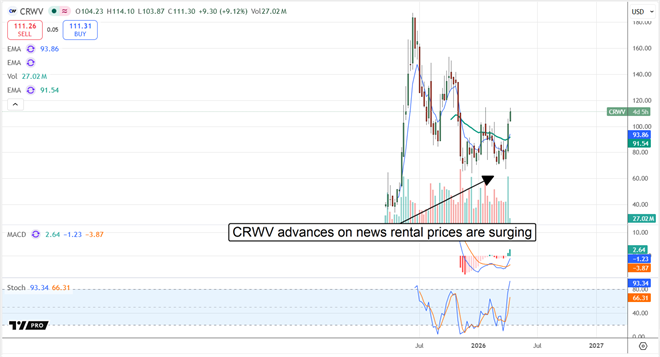
The biggest hurdle for the companies is the buildout, but it is underway. The biggest hurdle for investors is the cost of the build-out, which is being underpinned by debt and dilutive forces. Factors suggesting limited risk include swelling backlogs, with Nebius Group a prime example. Its debt load swells in 2026, with total liabilities approaching $8 billion by early 2026, but it is backed by a backlog of more than $45 billion.
Further Reading
- The Semiconductor Sector Is Hitting All-Time Highs: 2 Stocks Leading the Charge
- Ticker Revealed: Pre-IPO Access to "Next Elon Musk" Company (From Banyan Hill Publishing)
- Why Wall Street Is Betting Billions on This Under-the-Radar AI Stock
- This Elon-approved AI income stream could make you $30k-$50k a year (From InvestorPlace)
- JPMorgan Stock Is Coiling Near All-Time Highs — Here's What Comes Next
- Fastenal Stock Slips After Earnings: 5 Reasons To Buy the Dip
- Meta's Muse Spark Model: Big Improvements Reinvigorate Investors
Stay Ahead of the Market
The best investment opportunities don't wait. Get our research and stock ideas delivered straight to your smartphone—so you never miss a market-moving opportunity. Our text alerts ensure you see timely stock ideas and professional research reports instantly, whether you're in a meeting, commuting, or away from your desk.
